
FOX
Ferrofluid Optics eXperiment
KSat e.V. has been researching the use of ferrofluids for space applications for some time now. With PAPELL, FARGO, and FerrAS, we have already tested potential applications. These have included the development of low-wear switches, a reaction wheel, and pumps. The experiments have flown on sounding rockets and the International Space Station and have been a great success so far – both in terms of the results of the scientific evaluation and in public outreach. In the future, however, we also want to explore new areas of research.
Optics is a potential area for space applications that KSat e.V. has not yet explored. Here, we have come across magnetically deformable mirrors that can be made using ferrofluid. Research already exists in this area, but it is not intended for use in space. Therefore, we want to conduct a feasibility study as preparation for a future project (e.g., on a REXUS rocket) to lay the foundation for a possible application.

Our Experiment
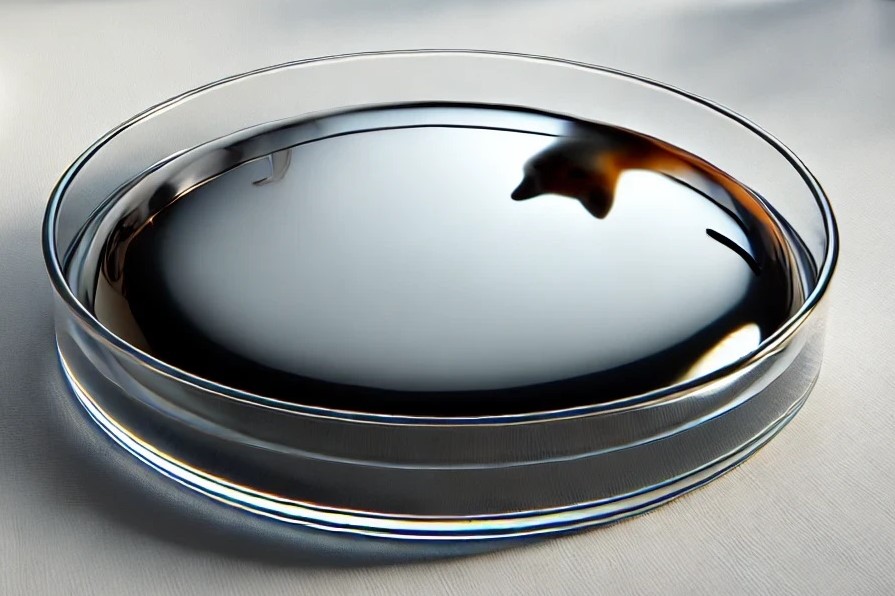
Ferrofluid-Mirror
This experiment aims to investigate the optical properties of ferrofluid and the implementation of a liquid mirror mechanism. In the long term, the mirror should be able to perform wavefront corrections, for example.
Wavefront corrections are optical adjustments that aim to compensate for distortions or aberrations in a light wave in order to smooth the wavefront—the area of equal phase—and thus achieve optimal focus or image quality. This technique is frequently used in adaptive optics, for example in telescopes, microscopes, or laser systems, to correct for influences such as atmospheric disturbances, irregularities in lenses or mirrors, and other sources of error.
FOX’s goal is to develop and test such a liquid mirror made of ferrofluid. To investigate its suitability for space applications, participation in a microgravity program will also be considered.
We want you!
Has FOX sparked your interest? We are always looking for new members!
Whether you are just starting your first semester or are already an aerospace expert, and regardless of what you are studying, we can find an exciting position for everyone in our team. All of our projects are organized into subsystems that are responsible for different areas. If you already know what you are interested in, please contact us!
FOX Subsystems
Structure
The experiment needs a home. This home must not only hold all components in place and ensure that no ferrofluid escapes, but it must also dissipate all the generated heat to the outside.
Simulation
A simulation should help to train and test the data evaluation of deflectometry.
FPGA
Since our data consists of camera images, we need a way to process this large amount of data quickly. For this, we plan to use an FPGA, which will be implemented and programmed.
Data
The generated data needs further processing before we can draw any conclusions. These processes will be developed and optimized for our application.
Power
The actual work of the experiment, which deforms the mirror, is done by electromagnets. These magnets require a great deal of energy. Both the magnets and the power management system must be developed and built.


Ferrofluids
Ferrofluids are fascinating materials consisting of tiny magnetic particles suspended in a liquid. These particles are often made of iron or iron oxides and typically measure only a few nanometers in size. The unique property of ferrofluids is that they respond to magnetic fields. When an external magnetic field is applied, the magnetic particles align themselves and create impressive visual effects, ranging from waves to pointed structures.
The discovery of ferrofluids dates back to the 1960s, when they were originally developed for use in space travel. The idea was to stabilize the liquids in gyroscopes used in satellites. Since then, the field of application has expanded considerably. Today, ferrofluids are used in technology, medicine, and art.
In engineering, ferrofluids are often used in seals and loudspeakers to control vibrations and reduce noise levels. In medicine, they could be used in targeted drug delivery by concentrating in specific areas of the body in response to magnetic fields. This could potentially facilitate the treatment of tumors by transporting drugs directly to the diseased cells.
Supporters und Partners